

Sep 16, 2026
Adacta sums up Digital Insurance CEE 2026: Straight-Through Claims, API-First Integration, and Pragmatic AI Shaping the Region
Digital Insurance CEE 2026 showed an industry moving quickly on AI, while the systems beneath it remain the limiting factor. The Warsaw program spanned two days and covered autonomous claims handling, AI-driven underwriting, and operational resilience under DORA, each of which rests on the same underlying condition: none of it works without accessible data and configurable processes at its core.
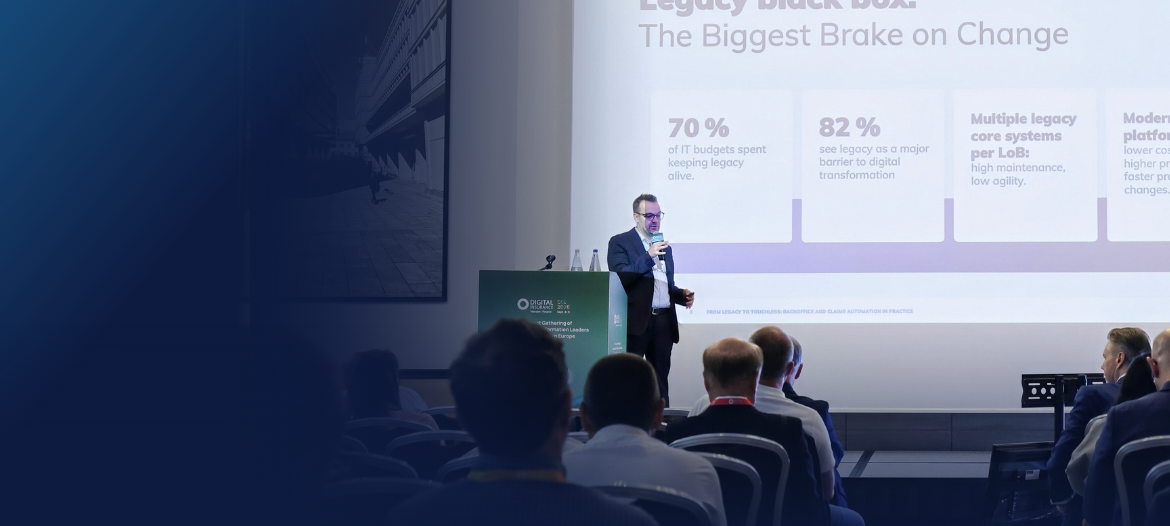
Adacta served as both a stage demo and an exhibition sponsor, with a demo delivered by Alexander Solomonov, Chief Commercial Officer at Adacta. The session was part of the Mastering Data & AI track, alongside presentations on agentic operations and autonomous claims workforces, and made a deliberately different argument: AI readiness is a consequence of core modernisation, not an alternative to it.
Data Before Models
Solomonov opened with Adacta's research on the regional market, noting that almost half of CEE insurers are already engaged in core replacement and a further 27 percent intend to begin within the next twelve months. The pressure, in his account, is not the inability to innovate but the cost of standing still, as maintaining ageing systems consumes budget and scarce technical capacity that modern platforms free up.
That constraint is most visible in data. Customer, policy, and claims data already exist within most insurers, but they are scattered across disconnected systems, which puts them out of reach of the models insurers are now planning to build.
"Most AI ideas fail on data access and data quality long before the model becomes the bottleneck," said Alexander Solomonov, Chief Commercial Officer at Adacta.
Conversations at Adacta's booth pointed in the same direction. Alongside AI, the recurring subjects across two days of meetings were data processing and migration.
Configurable, Not Hard-Coded
The same principle applies to process. Claims processes must be modeled rather than hard-coded, so they can be adjusted as products and regulations change, and automated end-to-end rather than passed between systems. A live demonstration showed a motor claim created, assessed, and settled within minutes, without manual intervention.
Architecture also determines what insurers can adopt from the wider market. New insurtech components emerge faster than any insurer can absorb them, from anti-fraud engines and OCR to image recognition and telematics. AdInsure's API-first design supports open integration with the broader ecosystem without bespoke development, and enables phased delivery that starts with the most business-critical area, whether that is sales, claims, policy administration, or billing.
AI Through a Pragmatic Lens
While much of the track focused on autonomous and agentic models, Adacta's position remained measured. The immediate gain is in configuration: AdInsure Studio Copilot allows IT teams and business analysts to submit product or process definitions and generate a configured baseline, reducing time-to-market from weeks to hours. In daily operations, AI serves as an assistant, providing additional checks and contextual data to claims handlers, back-office teams, and sales users, with the decision remaining in human hands.
"Legacy was a black box, and that was the problem. AI should not become the second one," said Solomonov.
"AI readiness comes second. The first step is replacing existing systems with a modern core that AI can actually work with."
The Warsaw agenda made the level of ambition around AI clear. The deciding factor will be whether the underlying core is modular, API-first, and configurable enough to support it. That is the requirement AdInsure and AdInsure Studio are built to meet.


